
XRP as Collateral
XRP Gains New Importance in Institutional Finance


According to Stevenson, the lack of market reaction stems from investors focusing almost exclusively on price movements while overlooking deeper structural changes within the financial system. Meanwhile, the inclusion of an asset within a regulated framework gives it an entirely new role. Accepting XRP as collateral signals a shift in its market position and marks a gradual entry into institutional finance.
Bitnomial operates under the supervision of the U.S. Commodity Futures Trading Commission (CFTC), and in derivatives markets, collateral plays a critical role. Institutions rely only on assets that are liquid, stable, and settlement-ready. Stevenson compared such assets to gold, U.S. Treasury bonds, and major currency pairs, emphasizing that volatile instruments cannot secure leveraged positions. It is also worth noting that a few months earlier, Bitnomial became the first regulated exchange in the United States to launch XRP futures contracts.
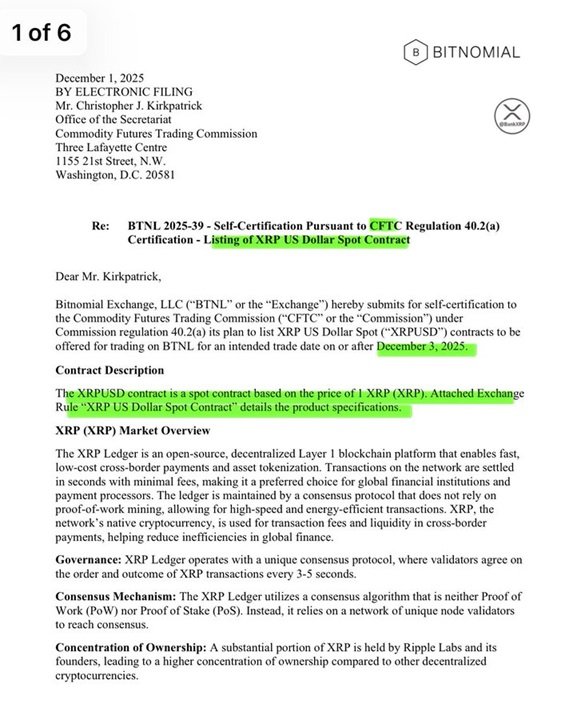
Stevenson also pointed out that regulators raised no objections to the use of XRP as collateral. Around the same time, settlement windows within the DTCC system were expanded—an adjustment that typically accompanies broader changes in clearing and settlement infrastructure.
The expert explained that the global derivatives market is worth hundreds of trillions of dollars, meaning that only assets capable of supporting massive settlement volumes can function as collateral. In her view, XRP is increasingly being treated as a commodity-grade settlement asset rather than merely a speculative token.
Using XRP as collateral may also affect supply dynamics. Assets posted as margin are usually locked up rather than sold on the open market. A reduced circulating supply, combined with growing institutional demand, could support valuations over time. Stevenson stressed that collateral status is not driven by price; instead, price adapts to the needs of institutional markets.
As a result of this shift, XRP may begin to appear on institutional balance sheets in new ways. Financial firms could hold it, pledge it as collateral, borrow against it, and incorporate it into more complex financial products. According to Stevenson, this development removes one of the key barriers that previously limited adoption—regulatory uncertainty.