
USDT Grows Despite Market Downturn
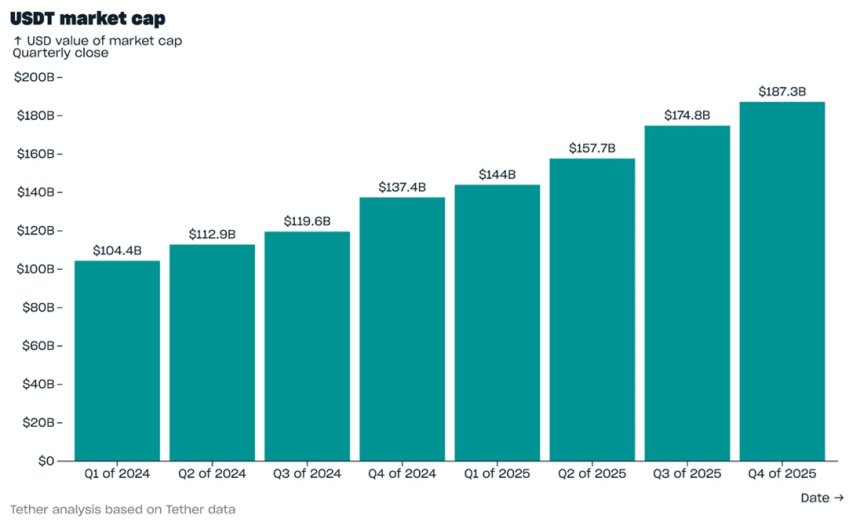
USDT hit a record $187.3B market cap in Q4 2025, expanding despite a broader crypto market decline.


USDT, the stablecoin issued by Tether, reached a record market capitalization of $187.3 billion in the fourth quarter of 2025. This growth came despite declines across the broader cryptocurrency market following a wave of liquidations in October. During Q4 alone, USDT’s market cap increased by $12.4 billion, reinforcing its growing dominance in the stablecoin sector.
Data shows that competing stablecoins struggled over the same period. Circle’s USDC ended the quarter at roughly the same level it held after the events of October 10, while Ethena’s USDe saw its market value drop by 57 percent.
USDT’s on-chain activity also reached all-time highs. The average number of monthly active wallets climbed to 24.8 million, accounting for nearly 70 percent of all wallets holding stablecoins. Quarterly transfer volume reached $4.4 trillion, while the total number of transactions hit 2.2 billion.
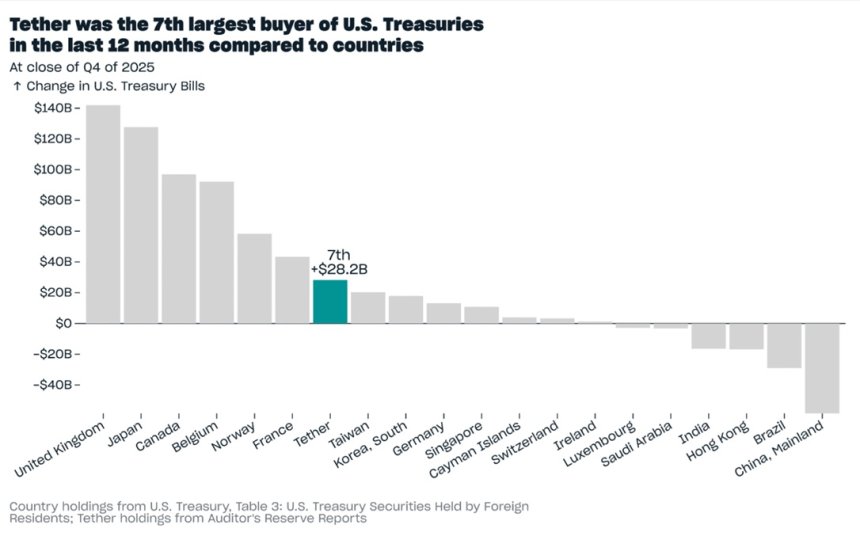
By the end of Q4, Tether’s reserves stood at $192.9 billion, up $11.7 billion from the previous quarter. Exposure to U.S. Treasury securities increased to $141.6 billion. Around two-thirds of the USDt supply is held in savings wallets and on centralized exchanges, with the remainder supporting payments, remittances, and DeFi activity.
A report by Bitrace indicates that in 2024, $649 billion worth of stablecoins flowed to high-risk addresses, with more than 70 percent involving USDT on the Tron network. In response, Tether is working with TRM Labs and Tron to monitor transactions and freeze illicit funds.
In January, Tether launched USAt, a stablecoin compliant with the U.S. GENIUS Act and issued by Anchorage Digital Bank. On Monday, the company also announced a partnership with Opera, integrating USDt and Tether Gold into the MiniPay wallet.
Against the backdrop of ongoing turbulence in the cryptocurrency market, the stablecoin sector remains relatively resilient. Recent data shows that users continue to rely on stablecoins as tools for storing value, settling payments, and transferring funds. Rising on-chain activity and sustained institutional interest suggest that, despite volatile market conditions, stablecoins continue to play a central role in the crypto ecosystem.