
Prediction Markets Signal Possible U.S. Entry into Iran
U.S. boosts forces in the Middle East; no ground entry into Iran yet, but escalation remains possible.

The United States is significantly increasing its military presence in the Middle East. According to available reports, the number of American troops in the region has already exceeded 50,000, with an additional 10,000 deployed in recent days. Reinforcements include Marines, infantry units, and elements of the 82nd Airborne Division.
The buildup began following U.S. and Israeli airstrikes on Iran on February 28. The conflict has now entered its fifth week and is increasingly being described as a war. Despite the growing troop presence, there is still no confirmation that U.S. forces have entered Iranian territory.
The Pentagon is preparing scenarios for limited ground operations. These could involve special forces and infantry units operating in strategic areas such as Kharg Island—through which around 90% of Iran’s oil exports pass—as well as regions near the Strait of Hormuz. For now, these remain contingency plans without formal authorization.
The administration of Donald Trump has not ruled out the use of ground forces but emphasizes that it wants to avoid a full-scale invasion. At the same time, informal diplomatic talks are reportedly taking place, with Pakistan acting as an intermediary.
Meanwhile, Iran is issuing warnings. Parliamentary Speaker Mohammad Bagher Ghalibaf stated that Iranian forces are ready to respond to any potential U.S. ground incursion. He also suggested that some media reports could be used to influence financial markets.
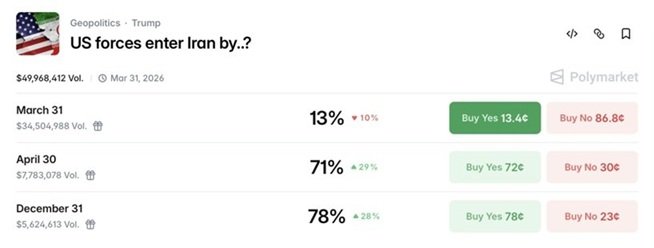
The situation is also drawing significant attention on prediction markets. On the Polymarket platform, users estimate a 71% chance of U.S. troops entering Iran by April 30, and a 78% probability by the end of 2026. Total betting volume has exceeded $49.6 million, highlighting the scale of speculation surrounding the conflict.
So far, military actions have largely relied on air and naval strikes. This approach resembles the early stages of previous U.S. operations in the region, where ground involvement remained a secondary option.
The current situation in the Middle East is triggering daily reactions across financial markets, including both stocks and cryptocurrencies. Incoming information is often contradictory, leading to sharp price fluctuations. This volatility makes it difficult for investors to determine market direction, resulting in lower trading volumes and increased uncertainty.