
Japan Sends a Warning Signal
Japan's bond yields hit a 30-year high, raising concerns over global markets and capital outflows.


Japan's bond market is flashing one of its strongest warning signals in more than three decades. The yield on Japan's 10-year government bonds has climbed to 2.84%, its highest level in over 30 years. According to analysts, this development could increase the risk of another major downturn across global financial markets.
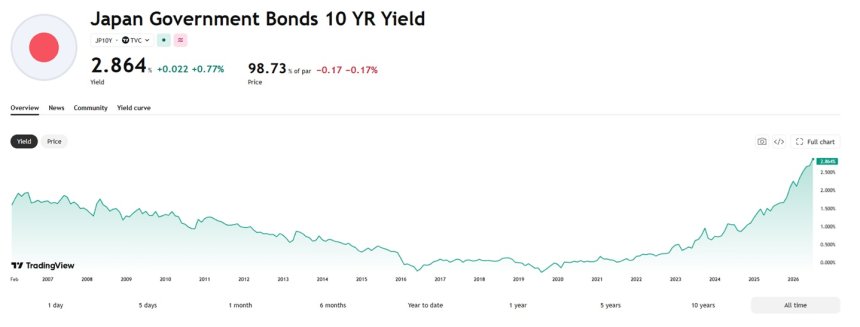
For years, Japan kept interest rates close to zero, allowing the government to finance its growing debt at very low cost. That environment is now changing. Over the past 12 months, the yield on 10-year government bonds has risen by 137 basis points, with the pace of the increase accelerating in recent weeks.
At the same time, demand for 20-year government bonds has fallen to its lowest level in years. Investors are becoming increasingly reluctant to buy long-term debt, while Japanese private banks are shifting toward shorter-term maturities. Despite weaker demand, the government continues to issue more long-term bonds. As a result, 20-year bond yields have reached their highest level in three decades, while the Japanese yen remains close to its weakest level against the U.S. dollar in 40 years.
The Bank of Japan is also changing its approach. For years, it was the largest buyer of government bonds, helping to keep borrowing costs low. It is now gradually reducing its bond purchases, even as the government plans additional debt issuance. This combination is putting further upward pressure on bond yields.
Analysts warn that the consequences could extend well beyond Japan. For many years, investors borrowed cheap Japanese yen and invested the proceeds in U.S. stocks, bonds, real estate, Bitcoin, and other digital assets. This strategy, known as the yen carry trade, is now estimated to be worth nearly $1.2 trillion.
Higher bond yields in Japan could encourage investors to bring capital back home from overseas markets. Early signs of this trend are already emerging. In June 2026, foreign investors sold approximately $19.2 billion (3.12 trillion yen) worth of Japanese government bonds, marking the largest monthly capital outflow since the beginning of 2023. According to the analysts, similar pressure was also visible in the cryptocurrency market, which ended June down 20.48%.
Why Does It Matter?
If investors begin shifting capital from overseas markets back to Japan, they may need to sell stocks, bonds, and cryptocurrencies that were originally purchased using low-cost yen financing. A larger wave of such selling could put downward pressure on asset prices worldwide. The greater the flow of capital returning to Japan, the stronger the potential impact on global stock markets and other financial assets.