Ripple and Circle Await Regulatory Decision
Summary: U.S. banks urge regulators to pause crypto trust bank licenses until clear rules are adopted.


A new debate has erupted in the United States over the role of cryptocurrency companies within the traditional banking system. At the center of the discussion are Ripple and Circle, both seeking to obtain national trust bank status.
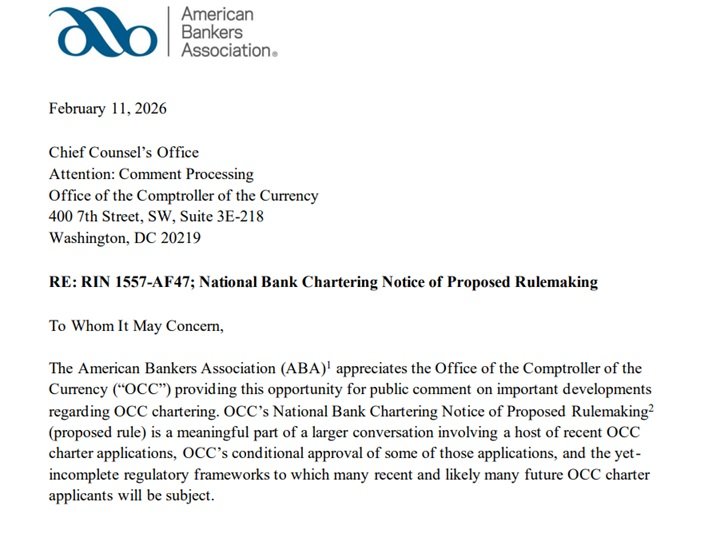
On February 11, the American Bankers Association (ABA), the largest banking industry group in the U.S., sent a letter to the Office of the Comptroller of the Currency (OCC) requesting a pause on issuing new national trust bank licenses to crypto-sector companies. According to the ABA, Congress should first establish clear regulations governing stablecoins and digital assets before such approvals move forward.
The association represents the country’s largest financial institutions, including JPMorgan Chase, Bank of America, Wells Fargo, Citigroup, Goldman Sachs, and Morgan Stanley, as well as thousands of regional and local banks.
Earlier, on December 12, the OCC announced conditional approval for five applications to establish national trust banks. The approved applicants include Ripple, Circle, BitGo, Fidelity Digital Assets, and Paxos. If they meet all regulatory requirements, they will join roughly 60 similar institutions currently supervised by the OCC.
OCC head Jonathan V. Gould emphasized that allowing new entrants into the federal banking system could increase competition and innovation, while expanding consumer access to financial services.
National trust banks differ significantly from traditional banks. They do not accept deposits or issue loans. Instead, they focus on asset custody, settlements, and escrow services. This structure is considered well-suited for cryptocurrency infrastructure and tokenized assets. For Ripple and Circle, federal oversight would provide greater credibility without the balance sheet risks associated with retail banking.
However, the ABA is urging caution. It has criticized linking approvals to compliance with the proposed GENIUS Act, noting that full implementation of the legislation could take years and may require additional rules from multiple federal agencies. The organization also points to the collapses of FTX and Celsius in 2022, arguing that new business models can create complex supervisory challenges. Additionally, the ABA warns that allowing non-deposit-taking institutions to use the word “bank” could potentially mislead customers.
Traditional banks are wary of granting companies like Ripple direct access to the Federal Reserve system. Such access would create meaningful competition in payments and settlement services. Crypto firms typically operate faster, rely on modern infrastructure, and often maintain lower operating costs—factors that could weaken banks’ positions in key segments of the financial market.