Fed Bets on a Gradual Expansion of the Money Supply
The Fed plans a slow, predictable increase in money supply, cooling investor hopes for aggressive stimulus.

The U.S. Federal Reserve is entering a phase of gradual monetary expansion. According to economist Lyn Alden, this will not involve aggressive money printing, as some parts of the crypto market had anticipated. Instead, the process is expected to be calm, steady, and highly predictable.
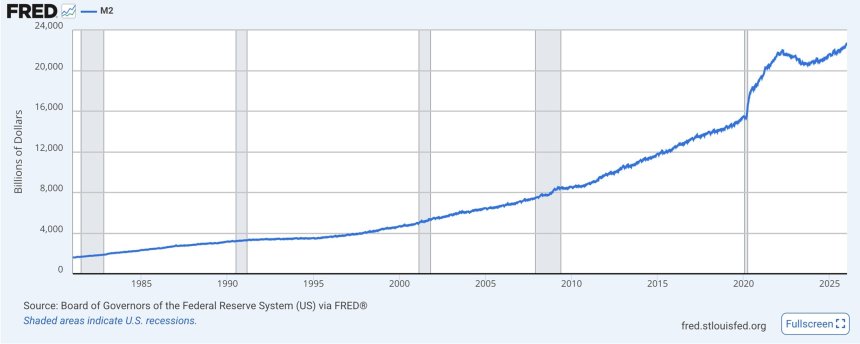
U.S. M2 money supply over the years
Alden believes that the Fed’s balance sheet will grow roughly in line with total banking assets or nominal GDP. Such a scenario would only provide moderate support for asset prices. In her view, investors should continue to hold high-quality scarce assets, while gradually reducing exposure in overheated market segments and increasing allocations to undervalued areas.
Her comments followed the nomination of Kevin Warsh as Chair of the Federal Reserve by U.S. President Donald Trump. The announcement triggered a nervous reaction among investors, who see Warsh as an advocate of a more restrictive interest-rate policy.
Interest-rate policy plays a crucial role in financial markets, including cryptocurrencies. Expanding the money supply and increasing credit availability are generally viewed as supportive for asset price growth. In contrast, higher interest rates and tighter monetary conditions often slow economic activity and put downward pressure on prices.
Market data suggests that expectations for rate cuts are weakening. According to CME FedWatch, only 19.9% of market participants expect a rate cut at the March meeting of the FOMC. Just a few days earlier, that figure stood at 23%.
Current Fed Chair Jerome Powell has acknowledged the challenging environment. Following the December FOMC meeting, he pointed to rising inflation risks and potential threats to the labor market, emphasizing that there is no risk-free path for conducting monetary policy.
Powell’s term ends in May 2025, and Kevin Warsh has not yet been confirmed by the U.S. Senate. This adds to investor uncertainty regarding the direction of U.S. monetary policy in 2026.