
Crypto in Australia and Crime
Less than 1% of cryptocurrency transactions in Australia are linked to illegal activity.


Illegal activity involving cryptocurrencies in Australia represents only a very small portion of the overall market. According to an analysis by TRM Labs, less than 1% of all on-chain transactions between March 2025 and February 2026 were connected to illicit entities. This suggests that the vast majority of operations within the crypto ecosystem are conducted for legitimate financial and business purposes.
During the analyzed period, Australian companies operating in the cryptocurrency sector processed approximately $50 billion in on-chain transactions. At the same time, around $15 billion flowed into centralized exchanges and decentralized finance (DeFi) platforms.
According to TRM Labs, Australia ranks 20th globally in terms of the total value of cryptocurrency received among the 95 countries included in the analysis.
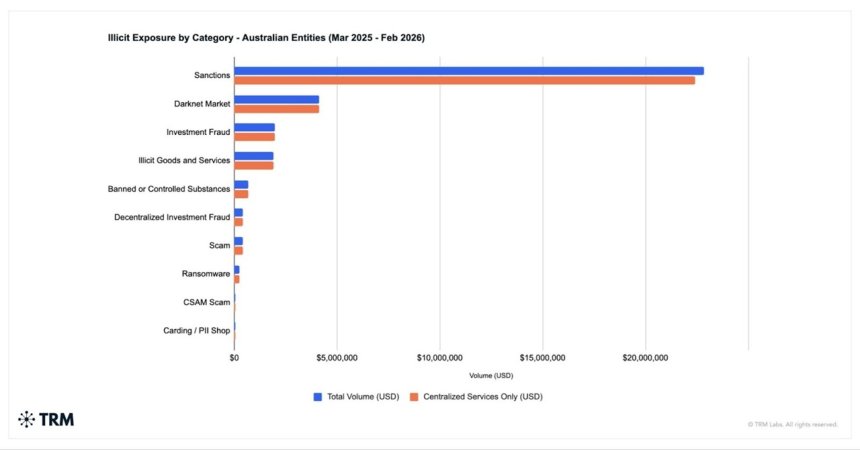
The largest share of identified illegal activity consisted of transactions linked to sanctions violations, accounting for roughly 70% of the total illicit volume detected. The second-largest category involved darknet marketplaces, followed by investment scams and the trade of illegal goods and services. Smaller portions were associated with prohibited substances, ransomware, various fraud schemes, terrorism financing, and cybercrime.
The report notes that while criminals increasingly use cryptocurrencies in familiar financial crime schemes, their share in the overall use of blockchain technology remains very low.
In the early days of cryptocurrency development in Australia, many criminal cases were primarily related to drug trafficking. Over time, however, the market has matured, and digital assets have become widely used in legitimate financial applications.
At the same time, authorities have tightened regulations and oversight of the industry. Since 2018, cryptocurrency exchanges have been required to register with the Australian Transaction Reports and Analysis Centre (AUSTRAC) and comply with anti-money laundering and counter-terrorism financing regulations. These requirements include customer verification, transaction monitoring, and reporting suspicious activities.
In 2025, Australia also recorded its first major conviction for cryptocurrency-related money laundering. The case was the result of a long-running investigation known as Operation Taipan, conducted by the Victoria Police, targeting a syndicate linked to China that used digital asset infrastructure.