
Record-Breaking January for Stablecoins
Record stablecoin volumes in January show capital staying in crypto, potentially fueling the next market rebound.


January delivered an unexpected signal in the cryptocurrency market. Stablecoin trading volume reached a record-breaking $10 trillion, even as the broader market remained firmly in risk-off mode. For comparison, total stablecoin volume for the entire previous year amounted to $33 trillion, meaning nearly one-third of that activity occurred within just 30 days.
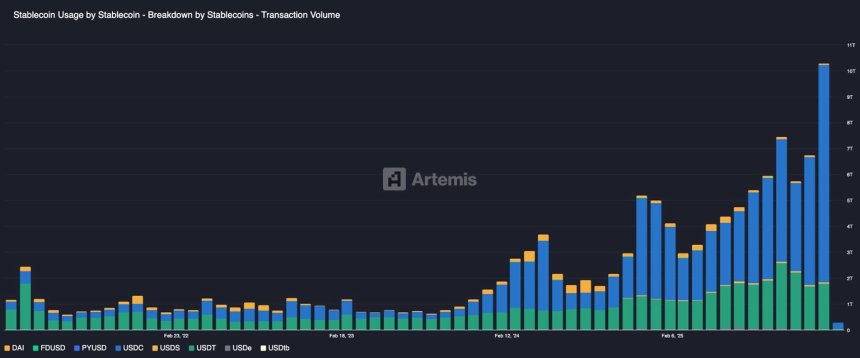
Importantly, this surge came during a challenging period for the market. Bitcoin lost 10.17% of its value, marking its weakest monthly performance since 2022. Despite this downturn, stablecoin liquidity continued to rise, suggesting that capital was not leaving the market but rather shifting into a different form.
USDC accounted for the largest share of January’s volume, processing $8.4 trillion in transactions. USDT followed with $1.8 trillion, while DAI contributed $58.1 billion. Together, these figures indicate that on-chain liquidity remained strong, even as investors avoided higher-risk assets.
Moreover, the data shows that stablecoins are increasingly used for more than just capital preservation. In January alone, $10.5 billion worth of USDC was minted on the Solana network. At the same time, the total value locked in real-world asset (RWA)–linked products grew by 8% to $1.19 billion.
Looking at the broader picture, the RWA sector saw even stronger capital inflows. Total value locked increased by 18%, or roughly $3.7 billion, reaching a new all-time high of $24.19 billion. This made RWA the best-performing market segment during the month.
This activity translated into growing structural demand pressure on the Solana network. Solana ranked fourth overall in January, recording $490 billion in transaction volume, despite SOL’s price falling by 16% over the same period.
According to data from Y Combinator, the startup accelerator, stablecoins are increasingly being used not only as a safe store of value, but also as a practical financial tool for funding early-stage companies and innovative projects.