AWS crash reveals Web3’s centralization problem
15-hour AWS outage exposes Web3’s hidden weakness — major crypto and fintech platforms paralyzed as reliance on centralized cloud infrastructure comes to light

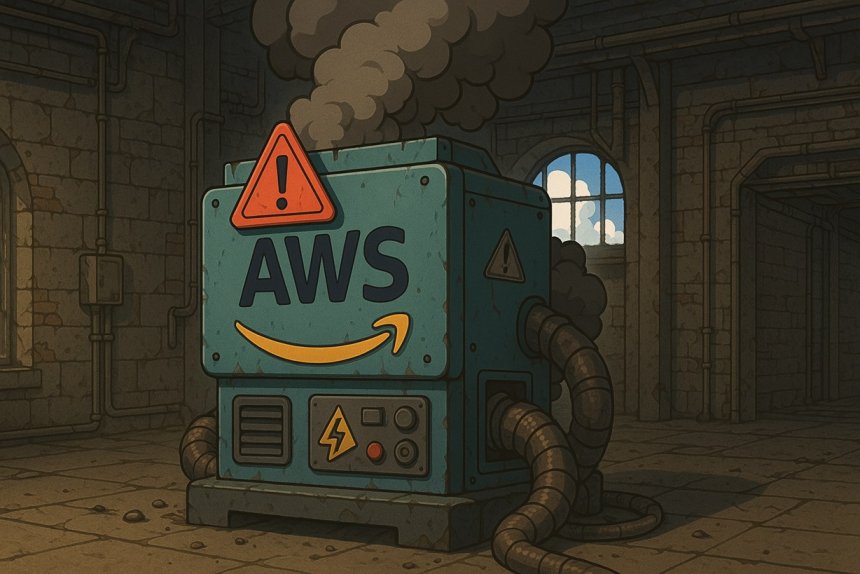
A recent 15-hour outage of Amazon Web Services (AWS) disrupted major cryptocurrency and fintech platforms, including Coinbase, Robinhood, MetaMask, and Venmo. Although the blockchains themselves continued to operate normally, millions of users were unable to log into their wallets or access their apps. The incident highlighted how much of Web3 still relies on centralized infrastructure.
Jamie Elkaleh from Bitget Wallet noted that decentralization works well at the blockchain level but not at the infrastructure level. In his view, true system resilience requires moving away from dependence on so-called “hyperscalers” — large cloud providers such as AWS, Google Cloud, and Microsoft Azure.
Elkaleh emphasized that full-scale decentralization remains difficult to achieve because most development teams rely on cloud services for their convenience, speed, and regulatory compliance. He believes the best path forward would be a “multi-domain” infrastructure model that combines traditional cloud servers with decentralized networks. This way, the failure of a single provider wouldn’t bring down the entire system.
Anthurine Xiang, co-founder of EthStorage and QuarkChain, shared a similar view. She pointed out that many Web3 services still run on centralized servers, which undermines the very idea of decentralization. Xiang compared the situation to “a house that’s fine, but the door got stuck” — the blockchains kept running, but users couldn’t access them because interfaces and APIs were hosted on AWS.
The outage began on Monday and lasted about 15 hours. During that time, the Coinbase app and the Base network went offline, while Robinhood users reported delays and API errors. MetaMask displayed zero balances, even though user funds remained safe — the issue was with the service fetching account data.
Jawad Ashraf, CEO of Vanar Blockchain, criticized the industry’s overreliance on the same cloud providers. It’s estimated that up to 70% of Ethereum nodes run on AWS, Google, or Microsoft infrastructure.
“It’s like paying three different landlords for the same building,” he remarked.
While building a fully decentralized infrastructure is technically possible, Ashraf admitted that most companies are unlikely to pursue it soon — mainly due to the added complexity and slower performance of such systems.
Elkaleh added that the AWS outage should serve as a wake-up call for the entire industry. He argued that the future of Web3 will depend not on how decentralized tokens are, but on how distributed the underlying infrastructure becomes. He also pointed to growing investments in decentralized cloud and storage solutions — such as Akash, Filecoin, and Arweave — as the direction in which the technology should evolve.