
U.S. Oil Reserves Fall to Lowest Level Since 1983
U.S. oil reserves have fallen to 311.4 million barrels, their lowest level since March 1983


When the United States ended the dollar’s convertibility into gold in 1971, the global oil trade increasingly supported the currency’s importance. Oil was traded primarily in dollars, while exporting countries invested some of their earnings in U.S. assets. This gave rise to the system known as the petrodollar.
However, the dollar was never formally backed by oil in the same way it had previously been backed by gold. Instead, the oil trade strengthened global demand for the U.S. currency and helped establish its dominant position.
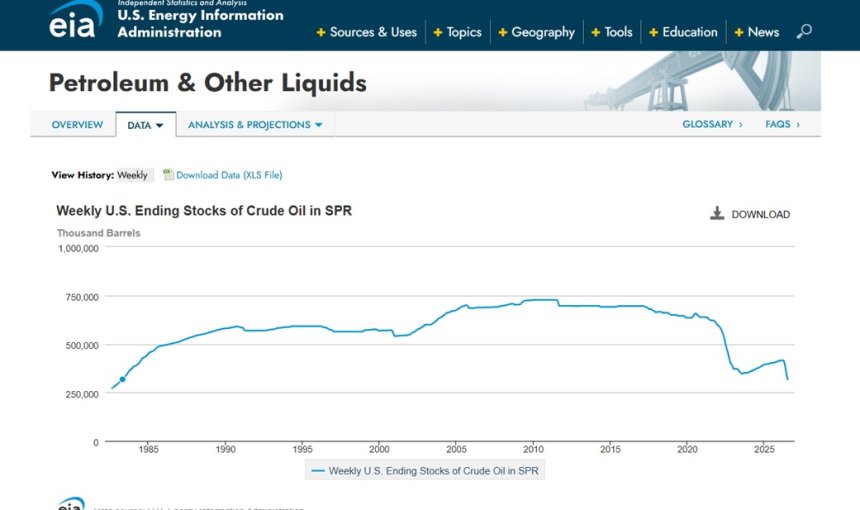
Today, a different signal is attracting attention. According to the latest data from the U.S. Department of Energy, the Strategic Petroleum Reserve has fallen to 311.4 million barrels. Around 5.1 million barrels were withdrawn in a single week, bringing the reserve to its lowest level since March 1983.
This does not mean that the United States is running out of oil. The Strategic Petroleum Reserve is an emergency stockpile, and its decline reflects an agreed release of 172 million barrels. The oil is being supplied to companies through an exchange programme and is expected to be returned later, along with additional barrels.
Nevertheless, the scale of the decline remains significant. Since the war involving the United States, Israel and Iran broke out in late February, the reserve has shrunk by 104.04 million barrels. As of 10 July, combined government and commercial inventories stood at 726.2 million barrels—the lowest level since 1984.
The situation in the Middle East remains far from resolved. Attacks are continuing, while tanker traffic through the Strait of Hormuz is restricted.
It is still too early to determine whether this marks the beginning of a broader oil crisis or merely a temporary shortage caused by the war and the plann