
KOSPI Under Heavy Pressure
Sharp losses in the KOSPI triggered forced selling of margin-financed stocks, accelerating market deleveraging.

The sharp sell-off on South Korea's stock market has triggered a wave of forced liquidations of shares purchased on margin, highlighting growing pressure on leveraged investors. According to data from the Korea Financial Investment Association, forced sales reached 344.2 billion won in July alone.
The largest single-day wave of margin call liquidations occurred on July 9, totaling 142.2 billion won. As the data is published with a two-day delay, it does not yet reflect the impact of the nearly 9% plunge in the KOSPI on July 13. Market participants expect forced selling to increase further as the latest decline is incorporated into the figures.
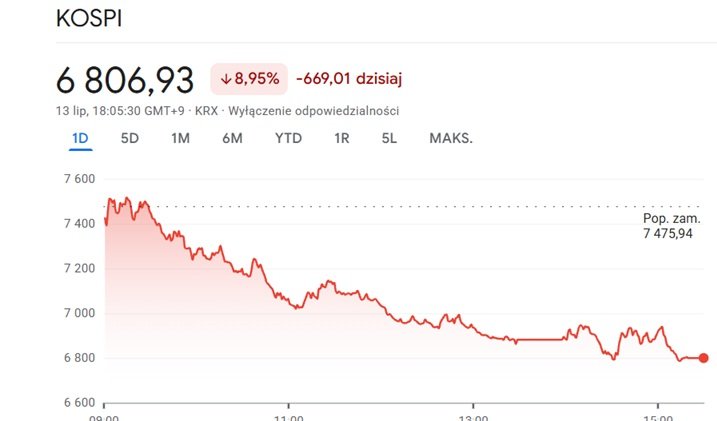
On July 13, the KOSPI closed 8.95% lower after a turbulent trading session. During the sell-off, the exchange activated both the Sidecar mechanism, which temporarily suspends certain trading activity, and the first-level Circuit Breaker designed to curb excessive market volatility.
The semiconductor sector was hit particularly hard. SK Hynix shares plunged 15.37%, marking the largest one-day decline in the company's history, while Samsung Electronics fell 10.7%.
At the same time, retail investor activity has weakened noticeably. The value of margin-financed trades, outstanding brokerage loans, and investor cash deposits have all declined. Analysts say this is reinforcing a deleveraging cycle in which falling share prices trigger forced selling, putting further downward pressure on the market.