Turkish Binance Cooperates with Bailiffs
Binance TR confirmed a debtor’s funds were seized, showing crypto accounts can face enforcement.


Many people struggling with debt see the cryptocurrency market as a space of greater financial freedom. It is not only about avoiding obligations, but also about having the ability to manage capital independently—without direct interference from officials or banks. However, a recent case in Turkey suggests that this perception is beginning to shift.
The Turkish branch of Binance, operating as BN Teknoloji A.Ş., responded to a formal request from the 23rd Enforcement Office in Istanbul regarding one of its users. Authorities asked whether the individual in question held an account on the platform and whether the assets stored there could be subject to seizure under Article 89(1) of the relevant enforcement law.
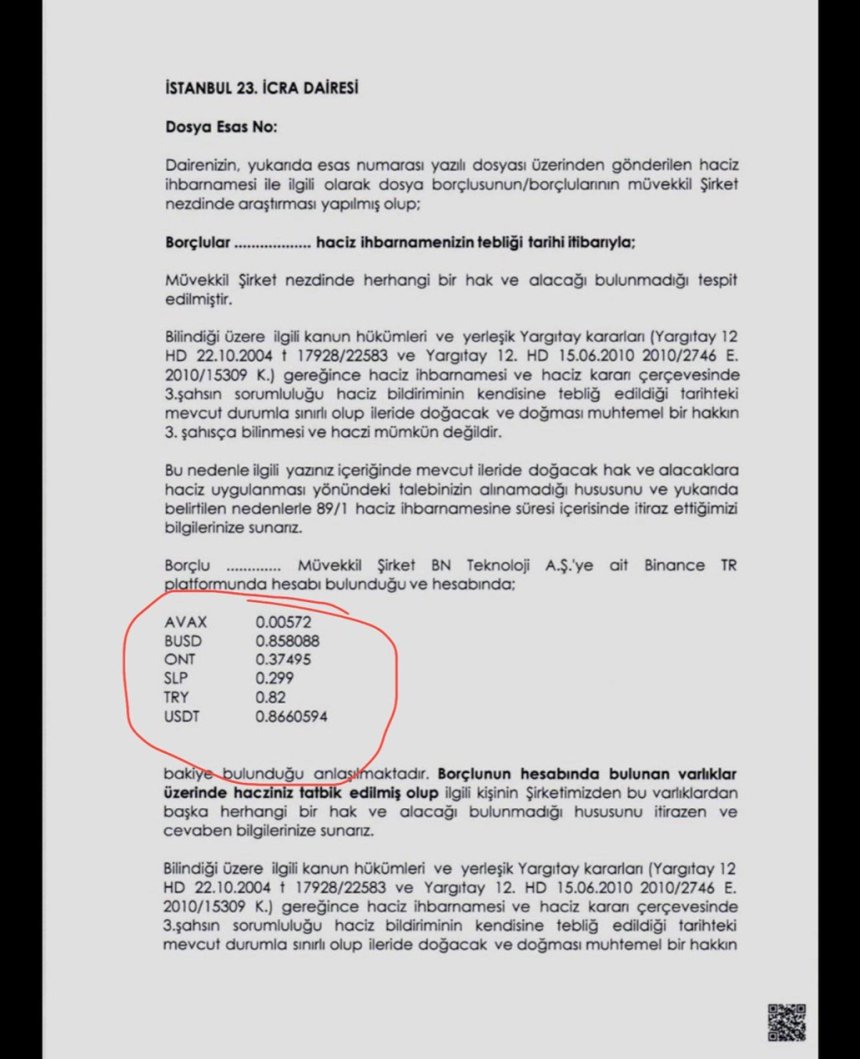
The exchange confirmed that the account existed and disclosed its balance. The holdings consisted of small amounts of cryptocurrencies and Turkish lira:
-
0.00572 AVAX
-
0.858088 BUSD
-
0.37495 ONT
-
0.299 SLP
-
0.82 TL
-
0.8660594 USDT
These funds were placed under seizure. The company further stated that no additional rights, claims, or receivables were associated with the account.
Importantly, Binance TR emphasized that, as a third party, it is liable only for the balance available at the moment the official notice is received. This means the seizure applies exclusively to funds held in the account at the time of service. Any future deposits are not automatically frozen and would require a separate legal procedure.
The case has sparked broad discussion, as it demonstrates that although cryptocurrencies are not formally recognized as legal tender in Turkey, they are treated as assets with economic value. In practice, this means that an exchange account can be subject to enforcement in a manner similar to a traditional bank account. For many users, this serves as a clear signal that the cryptocurrency market is no longer entirely beyond the reach of conventional legal mechanisms.