
Financial Firms Turn to Digital Assets
Digital assets are becoming essential for competitiveness in the financial sector.


More and more financial institutions are no longer treating digital assets as a novelty, but as a necessity. A study conducted by Ripple shows that as many as 72% of over a thousand industry leaders believe that without such solutions, maintaining competitiveness will be difficult.
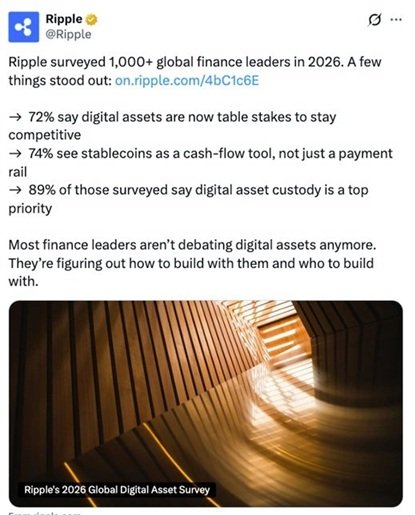
Stablecoins are attracting the greatest interest. According to 74% of respondents, they can improve financial liquidity and help unlock tied-up capital. Increasingly, they are seen not only as a payment tool but also as a component of corporate financial management.
The study included banks, fintech companies, asset managers, and corporations. A clear shift in approach is visible. Companies are no longer asking whether to implement digital assets, but how to do it. Building proprietary infrastructure or partnering with technology providers is becoming key.
Fintech companies are the most active in this space. As many as 47% of them plan to develop their own solutions, compared to just 14% among corporations. At the same time, 74% of non-financial firms intend to rely on external service providers.
Banks and asset managers are primarily focused on the secure storage of digital assets. For 89% of respondents, custody security is the most important factor when choosing a tokenization partner. Asset lifecycle management and distribution are also considered important.
Advisory support also plays a significant role. 85% of banks indicate a need for assistance in preparing asset issuance, while among asset managers, this figure stands at 76%.
Nearly all respondents—97%—emphasize the importance of security certifications such as ISO or SOC II.
The conclusions are clear: digital assets are no longer optional—they are becoming the standard. Financial firms are now focused on how to implement them effectively and with whom to partner.