
Yen Falls to Its Lowest Level in 40 Years
The yen hits its weakest level since 1986 as markets await a possible intervention by Japanese authorities.


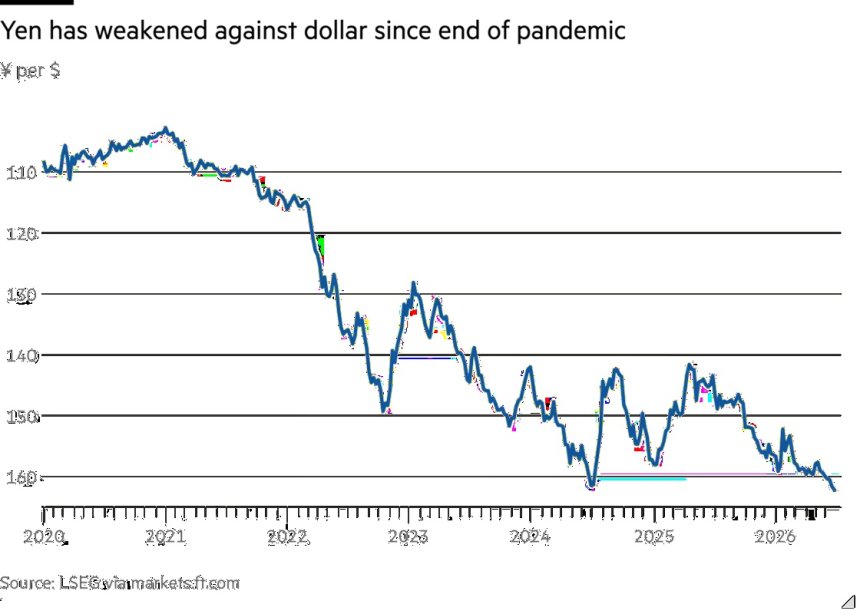
The Japanese yen has fallen to its weakest level against the U.S. dollar in nearly four decades. During Tuesday morning trading in Tokyo, the exchange rate climbed above 162 yen per dollar for the first time since December 1986. Since the beginning of the year, Japan's currency has lost more than 3% of its value.
The yen has come under pressure due to concerns about the economic impact of the conflict involving Iran and the Bank of Japan's ongoing struggle to bring inflation under control. Rising oil prices have added to inflationary pressures, while investors believe the central bank has been too slow to respond to changing economic conditions.
After the exchange rate reached 162.27 yen per dollar, Chief Cabinet Secretary Minoru Kihara said the government was prepared to intervene in the foreign exchange market if necessary. Investors are once again speculating that Japan could step in to support its currency, just as it did in April and May when it spent tens of billions of dollars to stabilize the yen.
The yen is also being weakened by the U.S. Federal Reserve's monetary policy. Expectations of further interest rate hikes in the United States continue to strengthen the dollar and encourage investors to move capital into U.S. assets.
Prime Minister Sanae Takaichi's economic plans have also influenced market sentiment. At the end of June, she announced a $2.3 trillion public and private investment program to be implemented over the next 14 years. However, the lack of details on how the initiative will be financed has raised concerns about higher government spending and growing public debt.
Additional pressure on the yen comes from the record-breaking rally in Japan's Nikkei 225 index. Last week, the benchmark climbed above 72,000 points, driven by strong foreign investment in companies focused on artificial intelligence and semiconductor technologies. Currency hedging related to these investments has further increased selling pressure on the yen.
Analysts believe that any intervention by Japanese authorities would likely provide only temporary support for the currency. Inflation in Japan stood at 1.5% in May. In mid-June, the Bank of Japan raised interest rates to around 1%, their highest level since 1995, but markets expect only one additional 0.25 percentage point increase by January. By comparison, the U.S. Federal Reserve is still expected to raise rates once or twice from the current range of 3.5% to 3.75%, a move that could continue to strengthen the dollar and keep the yen under pressure.